


English Leader- Emily Stanbridge
English
English teaching at St Augustine’s Catholic Primary Curriculum
Intent
At St Augustine’s CPS, we believe that a quality English curriculum should develop children’s love of literacy through reading, writing and discussion. We believe that language and literacy is fundamental to the overall development of the child and their access to the curriculum in all its aspects. We aim to deliver quality teaching of basic and higher order reading, writing and listening skills to enable children to become confident, successful and to foster skills, which will remain with them for life.
Implementation
The aims and objectives are embedded across our English lessons and the wider curriculum. We have a rigorous and well organised English curriculum that provides many purposeful opportunities for reading, writing and discussion. Teachers adapt and use the Talk for Writing scheme as appropriate to their classes, but also ensure that cross curricular links with concurrent topic work are woven into the programme of study. Our curriculum closely follows the aims of the National Curriculum for English.
Aims and Objectives
We want all our pupils by the end of Year Six to be able to:
- read and write with confidence, fluency and understanding;
- be able to orchestrate a full range of reading cues (phonic, graphic, syntactic, contextual) to monitor their reading and correct their mistakes;
- understand the sound and spelling system and use this to read and spell accurately;
- have fluent, joined and legible handwriting;
- have an interest in words and their meaning and a growing vocabulary;
- know, understand and be able to write in a range of genres in fiction and poetry, and understand and be familiar with some of the ways in which narratives are structured through looking at the author’s use of setting, character and plot;
- understand, use and be able to write a range of non-fiction texts;
- plan, draft, revise and edit their own writing;
- have a suitable technical vocabulary through which to understand and discuss their reading and writing;
- be interested in books, read with regularity and enjoyment and evaluate and justify their preferences;
- through reading and writing, develop their powers of imagination, inventiveness and critical awareness.
Impact
As a result we have a community of enthusiastic readers and writers who enjoy showcasing their developing literacy knowledge and skills. They are confident to take risks in their reading and writing, and love to discuss and share their ideas.
English Long Term Plan 2025-2026
Phonics workshop Sept 2026
Reading buddies
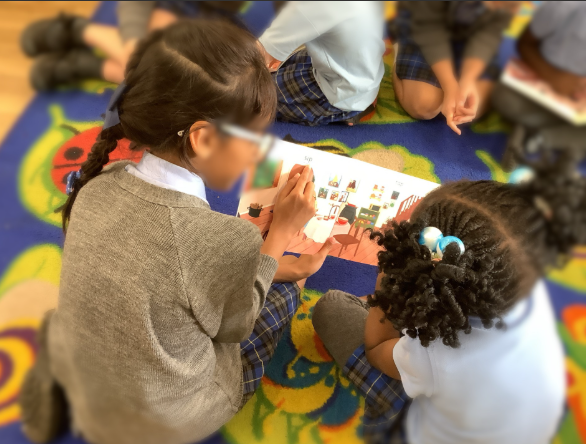
Some of our Year 5 students teamed up with our youngest learners in Reception this week for the launch of our new Reading Buddies program.
The afternoon was filled with excitement as the older children took on the role of mentors. They guided their younger partners through picture books, practiced phonics sounds, and shared their favourite stories
Year 3 Enjoy Listening to Year 1 Read
This week, our Year 3 children had a wonderful opportunity to spend time with the Year 1 pupils during a special shared reading session. The older children listened carefully as the younger pupils practised their reading skills, offering encouragement, praise, and support along the way.
Erika Graffin local author

Kash impressed the judging panel with his poem ‘The Sway of the Flowers’
We are immensely proud of Kash (Year 4, July 2025) for his winning poem!
In a creative writing competition, the children were asked to write a poem or story about what they could see out of their window or on their walk to school.
He was invited to the 'Topping Out' ceremony at the new Paramount Place in town, where got to be one of the first people to visit the tallest part of the building, looking over at all the beautiful views over Tunbridge Wells.
Well done Kash!

Year One have immersed themselves in all things Out and About!


World Book Day 2025


Visiting the Assembly Hall for Literary Week

Reading
Phonics and early reading policy
Reading and Phonics
“When we pray we speak to God; but when we read, God speaks to us.” - St. Jerome, Patron Saint of Reading
At Saint Augustine's, we recognise the huge impact that reading can have on the lives of our children. Daily reading, in the classroom and at home, is actively encouraged and children are supported with their learning in a multitude of ways.
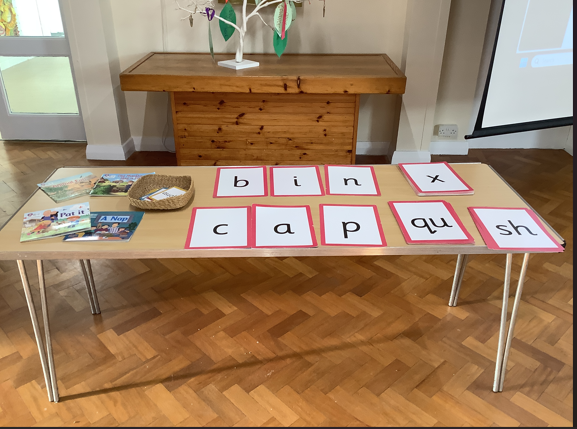
Starting with the 'Little Wandle Letters and Sounds' programme, children are taught skills of decoding and blending sounds together to form words. (See our Phonics page for more information)
Throughout the school, children are exposed to a great number of texts, as well as working through the Big Cats reading stages. An extensive selection of fiction and non-fiction books are available to read and borrow in our school library and we make regular trips to the local library where children are free to explore and borrow other books.
Reading in Early years and Key stage one
Focus and structure of the sessions
Children read the same book aloud in each of the three sessions with growing automaticity and accuracy. The pre-read and independent reading parts of the sessions are essential in providing the repeated practice needed for children to build fluency.
Each session in this ‘three read’ model has a clear focus:
• Read 1: decoding
• Read 2: prosody – reading with meaning, stress and intonation
• Read 3: comprehension – understanding the text. Each of these sessions follows the same structure:
• Pre-read: Revisit and review
• Reading practice: Practise and apply
• Review: Pacy review of any misconceptions
Reading VIPERS
At our school, we are committed to helping every child become a confident and thoughtful reader.
That’s why we use Reading VIPERS - a set of strategies that focus on key reading skills:
Vocabulary, Inference, Prediction, Explanation, Retrieval, and Sequencing/Summarising.
Each week, our pupils explore a variety of texts and practise these skills through engaging questions and discussions.
This approach not only builds comprehension but also encourages children to enjoy reading and talk about books with greater understanding. Reading VIPERS helps us support every child’s progress and love of reading.

Reading at Home
Supporting children to read at home is a great way to build confidence and develop a love of books.
Each day, aim for at least 15 minutes of reading; twice a day is better! Once after school and again before bedtime could include reading aloud together, listening to audiobooks, or letting children explore books independently.
Celebrate your child's progress, ask questions about the story, and make reading a fun and relaxed part of the daily routine.
Have a look at the information sheets below for ways to support reading and questioning at home.
Thank you to www.webuybooks.co.uk for donating books to our library!